Severing the Severances
A Buddhist devotional of formal logic, for the benefit of beings

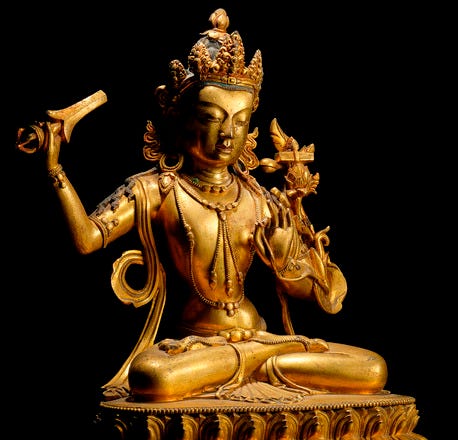
Herein I pay obeisance to the buddhas and bodhisattvas of all world ages. May benevolence and insight rain down on all beings within their own heart-minds; may the great sword of transcendent Manjushri, capable of killing and of giving life, cut through life and death. May the boundless sound basis, extolled by Nagarjuna and the World Honored One, flow endlessly without remainder. Nothing to follow stems from my mind. Mind, expedient, pervades what follows, without origination or extinction.
One recalls the World Honored One, near to Parinirvana, informing Venerable Ananda that his lesser rules could be abolished after the dissolution of the skandhas. Great Mahakasyapa criticized the failure of Ananda to inquire as to what the minor teachings were, and the first great council decided in their fulminant wisdom to preserve all of the Tathagata’s teachings.
Surely the World Honored One knew his speech carried ambiguity. Surely one who turns the great wheel of Dharma has an eye above the eyes, knowing of dependent origination, knowing of conceptual proliferation. Surely the Tathagata saw what transpired before it arose: argumentation over doctrine, confusion over which rules held the grand essence of the true way of teaching.
It is claimed that the second council arose via disputes over the ten points, most prominent among these the acceptance of gold and silver from laypersons. It is claimed that a schism emerged, dividing the orthodox and the heterodox into the Sthavira (“elders”) and the Mahasamghika (“Those of the great Sangha”). It is oft claimed that Theravada traces back to these esteemed elders, and Mahayana traces back to these Mahasamghika upstarts.
Throughout Heaven and Earth, may those who read these words know who alone is honored.
What shall be said here is like a pale shadow upon an ocean. Taking shape, it is not formed; Taking form, it is not shaped. Within shape, it is form. Within form, it is shape. The clear sight of buddhas and bodhisattvas beholds the basis beyond basis.
It is said that medicine is provided as appropriate to causes and conditions. I vainly offer this medicine, already contained within the illness.
Prior, a formula was posited reflecting the structure of dependent origination. The prior work is helpful to understand, but will be conventionally summarized and given here:
No proposition has a necessary truth status. The prior proposition has no necessary truth status, and the wheel in this way turns without halt. The structure of this is asserted and shown as correct. The structure is of endless refutation that unfolds without temporal basis or finite terminus, yet shapes expression of a firm, pervasive point of truth in its uniformity.
This is provisionally held to be one with the Great Teaching, and is true, not false.
May all doctrinal disputes be resolved upon elaboration.
Prasangika and Svatantrika
It is held that Prasangika is the avoidance of assertions and operation within an opponent’s frame of reasoning to unsettle the grounds of the opponent’s reasoning via consequence. It is held that Svatantrika is the embrace of assertions, premises and conclusions to clarify groundlessness, positing the true teaching and removing doubt from the opponent’s mind.
Across Nyingma, Kagyu, Sakya, and Gelug, teachers have disputed whether this difference marks a final opposition or a difference of method. The Wish-Fulfilling Jewel, the Dalai Lama, has stated that the teachers of various systems all “arrive at the same intended point”, deep and difficult for reason to establish.
Here, reason is established.
The Prasangika mechanism is the rejection of any proposition in holding a necessary truth, iterating in rejection upon rejection without beginning or end. The Svatantrika mechanism is what one says of the shape of such rejections as a conventional assertion, empty of svabhava. These rejections compound to a depth beyond all the grains of sand along all the beaches of all the sand-grain worlds, to a length beyond Mount Sumeru and beyond the grim hells, to a width beyond every universe and every age. This infinity is no different from provisional syllogistic assertion. The incomparable Diamond Sutra tells us: “Since the possession of attributes is an illusion, Subhuti, and no possession of attributes is no illusion, by means of attributes that are no attributes the Tathagatha can, indeed, be seen.”1 The Heart Sutra, the unexcelled Prajnaparamita, declares: “No eye, no ear, no nose, no tongue, no body, no mind” to be “true, not false.”2 Where can there be a necessary distinction?
Those whose hearts are set on the great vehicle but whose eyes remain clouded compound fault upon fault in their viewing of necessary faults in others. The sage Tsongkhapa held the Southern Indian master Bhaviveka to presuppose svabhava and inherent existence. The great Ju Mipham disagreed, distinguishing between the approximate ultimate of positive assertion and the ultimate in itself disclosed through pure negation, with those attaining understanding moving from approximate to ultimate without necessary failure in either.
Even so, we hold this progression to be merely conventional distinction. Prasangika and Svatantrika are two banks of a river. Without one bank, the other bank holds no function. The consequence of negation is positivity within negation. The consequence of position is negation within position. Without this, how could things exist? If one subordinated the other, the great Nagarjuna would have no purchase in clarifying the Dharma’s all-encompassing truth.
In Western translation: Prasangika is the application of the operation of the formula ¬□(v(P) = t) ∧ ¬□(v(P) = f) ∧ ¬□(v(P) = b) ∧ ¬□(v(P) = n) in all modal logical systems weaker than S5. Svatantrika is expressive of the uniformity of modal truth across an S5 equivalence class, and the consequent lack of self-iterability therein.
Rangtong and Shentong
The incomparable schools of Tibet have similarly aligned themselves along a deep, comparable dualism.
Rangtong, of a cousin to Prasangika and often associated with the Gelugpa school of virtue, holds that emptiness is empty of self-nature in all relative and absolute respects.
Shentong, a cousin to Svatantrika and expounded by the Jonang school, holds that emptiness holds a Buddha-nature, empty of the relative but containing luminous qualities and therefore not empty of itself.
Modern conceptions have sought to marry these divisions in their wisdom, key proponents among them the great Mipham and the estimable Rimé movement. Mipham here provides a lion’s roar, dispelling the fears of those along the true path. He posits Shentong as a third turning of the great wheel manifesting as Buddha-nature, and Rangtong as the second turning manifesting as the recognition of the emptiness of phenomena. The great result, then, is of unity of emptiness and appearance in which such disputations vanish in the light of the one vehicle. He rejects strict Rangtong and strict Shentong as missing the mark of the Middle Way.
Conventionally, we must again insist that such directional distinctions are provisional, not necessary, and one does not exist without correspondence and interrelation to the other.
Buddha-nature itself – this luminosity – is how one understands that endless negation of necessity holds in all systems, and this pervasiveness has expressible character that is not necessarily false. What is exhibited from endless negation of necessity? Something that is conceptually ever-present, yet without characteristics; something that does not have a location to exist in, and therefore exists unbound to location; something that does not necessarily depend on time, conceptually available at every moment and span of moments.
In Western translation: Rangtong is the general operation of the formula in all logical systems weaker than S5. Shentong is expressive of the uniformity of modal truth across an S5 equivalence class, and the consequent lack of self-iterability therein. In expression, then, structural equivalence is held between how Prasangika and Rangtong operate in mutual co-constitution with Svatantrika and Shentong.
Gradual and Sudden Enlightenment
The debate of two years at Samye Monastery in the 8th century C.E. is claimed to have resolved a grand dispute in the achievement of enlightenment within Tibet. Following a debate between the Indian gradualist school formed by Santaraksita and Moheyan’s Channists of China, espousing suddenness, the 38th King of Tibet Trisong Detsen favored the Indians, and cast Moheyan and his school from Tibet.
Nevertheless, the Dzogchen (“Great Perfection”) lineage in Tibet holds many sympathies to sudden enlightenment, while the rest of the Tibetan traditions generally remain faithful to the King’s adjudication.
In China, Moheyan’s suddenness doctrine ripened through long conceptual disputes between masters Shenhui and Huineng, and between the Southern and Northern Schools. As the medieval period progressed, the distinction between sudden and gradual was critiqued and merged into a finer non-dual recognition in the views of master Zongmi and Korean Seon master Jinul, albeit with a directional character. To both, insight is sudden, to be followed by gradual practice.
In truth, no intrinsic distinction between sudden and gradual has ever been secured. How could true understanding of emptiness hold the characteristic of arising necessarily gradually? How could true understanding of emptiness hold the characteristic of arising necessarily suddenly? It is prior established that Buddha-nature does not depend on time, pervading irrespective of time; it does not exist wrapped up in the immediate present any more than it exists across a span of years or eons. As it is not respective of time, it is accessible from the position of the immediate present, and it is accessible across a span of years or eons. It does not move, and it does not stay in place. The interpenetration of sudden and gradual is complete.
In Western translation: The process of gradual enlightenment is the development of facility in the operation of the formula in all logical systems weaker than S5. The realization of sudden enlightenment is the enaction of the formula without self-iterability within the S5 system. The Great Teaching does not bind itself to one modal register.
*****
The Tathagata met various metaphysical concerns with silence, all while expounding the unparalleled and unequalled beauty of dependent origination. Nagarjuna expounded the Buddha’s grand teaching, rising like Mount Sumeru over the world. Writing the Mulamadhyamakakarika to spring forth endless truth, he then wrote the Vigrahavyavartani, the dispeller of disputes.
The concerns dividing those along this profound and subtle path are no different in kind.
May all disputes be dispelled, and may peace be perceived as one with the Dharmakaya reality body – may lotus petals perfume the endless universes, Buddhahood shining within the pores of existence, and may sorrowless peace bear fruit upon the fields of cognition.
Gate gate pāragate pārasaṃgate bodhi svāhā.
Red Pine, 2001, p. 4
Red Pine, 2005